
Learning Games for Adults: 11 Picks That Teach You Something Real
Most of them train you to be good at the game and nothing else. See which ones leave you knowing more.
Last updated: Nov 18, 2026
Read time: 12 min
By Nibble Team
Nibble's Editorial Team
Our editorial team loves exploring how things work and why. We’re guided by the idea that people stay curious throughout their lives — they just need engaging stories and ideas to reignite that curiosity.
In January 2016, the Federal Trade Commission made Lumos Labs pay $2 million over ads claiming its Lumosity games helped people perform better at work, at school, and in daily life. The company could not produce the science to back those claims. Keep that in mind while you shop for learning games for adults, because a game can be popular, polished, and still leave you knowing nothing new.
The word "learning" sits on products that do completely different things. Learning games for adults are games that teach subject knowledge rather than train a single cognitive skill. Plenty of apps wearing the label do the opposite, and the category on the App Store tells you almost nothing about what you just downloaded.
So treat this as a sorting job rather than a ranking. You get one test you can run on any game sitting on your phone tonight, plus 11 learning games for adults grouped by the mental move each one demands. If you want the short version of the first group, Nibble runs Trivia Quiz and Complete the Picture rounds in a few minutes.
Disclaimer: This article covers memory, attention, and brain training claims for general interest, and results vary from person to person. Nibble is a microlearning app, not a medical or clinical cognitive training tool.
Skip to the point: What learning games for adults leave you with
Four kinds of games sit behind one label, and only one of them leaves you with facts you can repeat.
- Learning games for adults split into recall, reasoning, skill drills, and table games.
- Recall games are the only type that hands you facts you can repeat.
- Brain training scores climb with the trained exercise, rarely on anything outside it.
- One test fits any game: name a new true sentence afterward.
- Session length runs from two minutes of trivia to an hour of table play.
Nibble's Trivia Quiz and Complete the Picture sit in that first group, and its Logic and Psychology topics scratch the itch that pulls people toward puzzle apps. Keep reading for all 11 picks, the test, and where each kind fits in a normal week.
Three different products are sold under one name
Learning games for adults are games built to leave subject knowledge behind, and three very different products compete for that description.
- Brain training apps sell cognitive exercise. They time you on attention, speed, and pattern tasks, then chart the results. These are the cognitive games for adults advertised with graphs.
- Puzzle and word games sell one reasoning move under pressure. A Sudoku grid asks you to eliminate possibilities. Pleasant, satisfying, and content-free.
- Knowledge games sell subject matter. A question about why the Roman Republic collapsed leaves you with an answer you can say out loud at dinner. That line separates the games that help adults learn from most educational games for adults on the shelf.
Twenty minutes of Sudoku and twenty minutes of a history quiz feel similar while you play. The next morning, only one has given you something to say.
A fourth group never shows up in search results at all: games that need other people in the room. They teach differently, because you explain your thinking out loud while someone argues back.
Why being great at a game rarely makes you better at anything else
Playing a brain game makes you better at that brain game, and the improvement rarely shows up anywhere else. Researchers call this the transfer problem, and it is worth understanding before you pay for anything.
Practice makes you better at the task you practiced, and the gains stop at the edge of that task. In January 2016, the FTC settled with Lumos Labs for $2 million over advertising that its games improved performance at work and at school without evidence to support it. That finding was about unsupported claims, never a ruling that the games do nothing.
So the honest summary of brain games for adults runs like this: scores go up on the exercise you repeat, and carry-over to work, everyday memory, or protection against decline is the part nobody has substantiated. For the longer version, this guide on brain training apps and what the evidence shows covers the research.
Knowledge works differently. A fact about the 1883 Krakatoa eruption is simply a fact you now have, and it never needs to transfer anywhere to be worth something. That is the case for games that teach content when your goal is knowing more.
💡 Grab the Nibble app and turn your spare minutes into a satisfying breakthrough!
The one-sentence test for any game you already have
Call it the one-sentence test. After a session, say out loud one true sentence you could not have said before you started. If no sentence exists, the game trained you rather than taught you.
Two quick examples of the test in action:
- A Sudoku round fails it because the sentence does not exist. You solved a grid and learned nothing about the world.
- A trivia round passes it when the answer arrives with a short explanation, so you walk away saying something like "Krakatoa was heard 3,000 miles away."
Then run the next-day version. Try the same sentence 24 hours later, with no app open. Games that asked you to retrieve an answer usually survive the night. Games that only showed you an answer usually do not, which is why active learning activities beat passive ones for knowledge retention.
11 learning games for adults, grouped by what they ask your brain to do
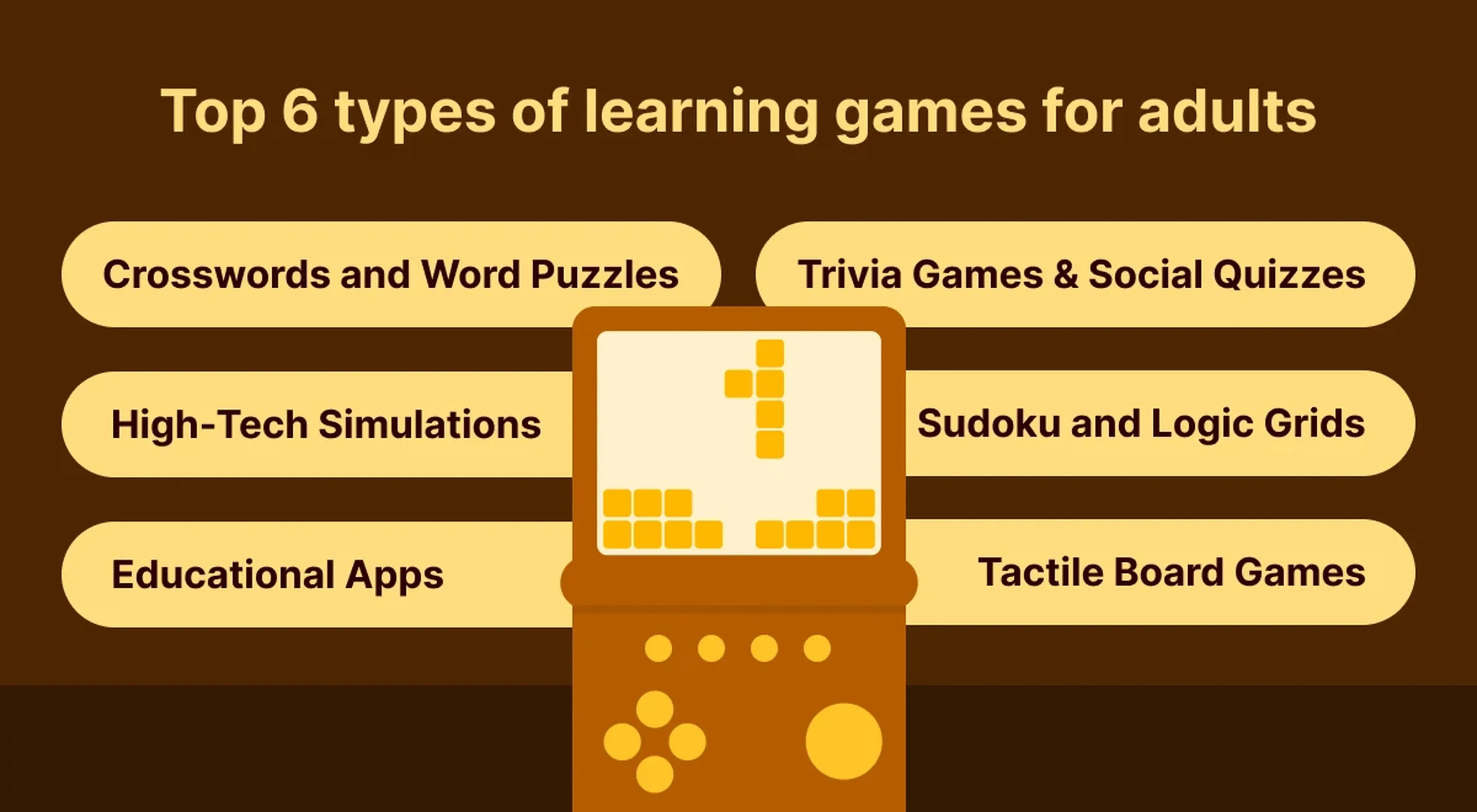
The best learning games for adults get easier to compare once you sort adult learning games by mental move rather than by star rating, so the 11 picks below run as one list across four groups.
Prices below are current as of November 2026 and listed in US dollars. App pricing changes often and varies by region, platform, and promotion, so check the app or its website before you subscribe.
Three games that make you pull a fact back out of your head
Being asked a question forces a different action than being shown an answer. Retrieval is why this group leaves facts behind, and it covers the best educational games for adults, most trivia games for adults, and general knowledge games.
- Nibble. The clearest example of the retrieval pattern in app form. Trivia Quiz asks a question, confirms the answer, then explains why it's right, and Complete the Picture does the same visually. The library runs 35+ topics and 670+ pieces of content across STEM, humanities, and practical subjects, with sessions from 1.5 to 15 minutes. It is not a course platform or a soft-skills trainer, and it fits scattered adult time instead of a study schedule. See the games built into Nibble for how each format plays. Honest limit: it is not a clinical cognitive training tool and does not claim to be.Pricing: a 7-day free trial, then roughly $19.99 a month, $39.99 for three months, or about $59.99 a year, with your rate shown at checkout.
- Trivia Crack. The social quiz standard, strong on breadth and competition. A wrong answer often passes without teaching you why, so the explanation layer stays thin, and the free tier leans hard on ads. Still a fast way to find your weak spots before a round of general knowledge trivia with friends. Pricing: free on iOS and Android, with in-app purchases for coins and an ad-free upgrade.
- Seterra by GeoGuessr. Free map drilling on countries, capitals, rivers, and flags, and one of the few fun educational games for adults where you measurably know more after a week, because the thing being tested is the thing being learned. That also makes it a strong pick among memory games for adults. Weakness: one subject, plain interface. Pricing: free, with 300+ quizzes on the web and in the mobile app.
Three games that make you reason rather than recall
This group gives you faster pattern recognition inside one puzzle type plus a pleasant few minutes, and no new subject matter. Most free learning games for adults sit here, alongside the game apps that earn their place on a phone, and they double as logic games for adults or problem-solving games for adults.
- Wordle and the NYT Games set. One puzzle a day, a hard stop, and a steady vocabulary nudge. The daily limit is a feature for adults who overplay. The wider set adds crosswords and other word games for adults, so as vocabulary games for adults and reading games for adults go, it stays light but consistent. Pricing: Wordle is free daily; the full NYT Games subscription runs about $4.99 a month or roughly $40 a year.
- Chess.com puzzles and lessons. The one entry here that crosses into teaching, because the lessons attach named concepts like forks and pins to real positions. The free tier caps daily puzzles. Among strategy games for adults, it doubles as practice for critical thinking games. Pricing: free to play; Gold is $6.99 a month or $49.99 a year, Platinum $10.99 or $79.99, and Diamond $16.99 or $119.99.
- Sudoku. Pure logic, zero content, free almost everywhere. Worth playing anyway if the point is a calm ten minutes, and it holds up against the concentration games for adults sold at a premium. Pricing: free in dozens of apps, on puzzle sites, and in most newspapers.
Three games that drill one skill until it runs automatically
Drills work, reliably, for the exact thing drilled. That is the transfer problem stated as a feature. Brain training games for adults and skill development games for adults both live here, and both reward showing up daily.
- Duolingo. The best-known drill with a game loop around it, and the streak does real work on consistency. It stalls on production and conversation, since recognizing a sentence is easier than building one. Of the language learning games for adults available, it has the gentlest on-ramp, and this review of how effective Duolingo is over months covers what the streak buys you.Pricing: free with ads; Super sits around $13 a month, and annual plans land between roughly $84 and $120 depending on the offer you are shown.
- SoloLearn. Code in short, quiz-based chunks, which is strong for syntax recognition. Building an actual project is a separate skill the app cannot hand you. Pricing: course content is free; PRO is $12.99 a month or $69.99 a year, and MAX is $119.88 a year.
- Elevate. The exercises are well made, and the daily structure suits people who like being measured, with sessions built around working memory exercises, cognitive flexibility exercises, and other games to improve cognitive skills. Apply this article's own test openly: the score goes up, and the new sentence usually does not exist. Sold as games to improve memory and concentration, it delivers on the first half. Pricing: free tier with three games a day; Pro is about $9.99 a month or $39.99 a year.
Two games that need other people in the room
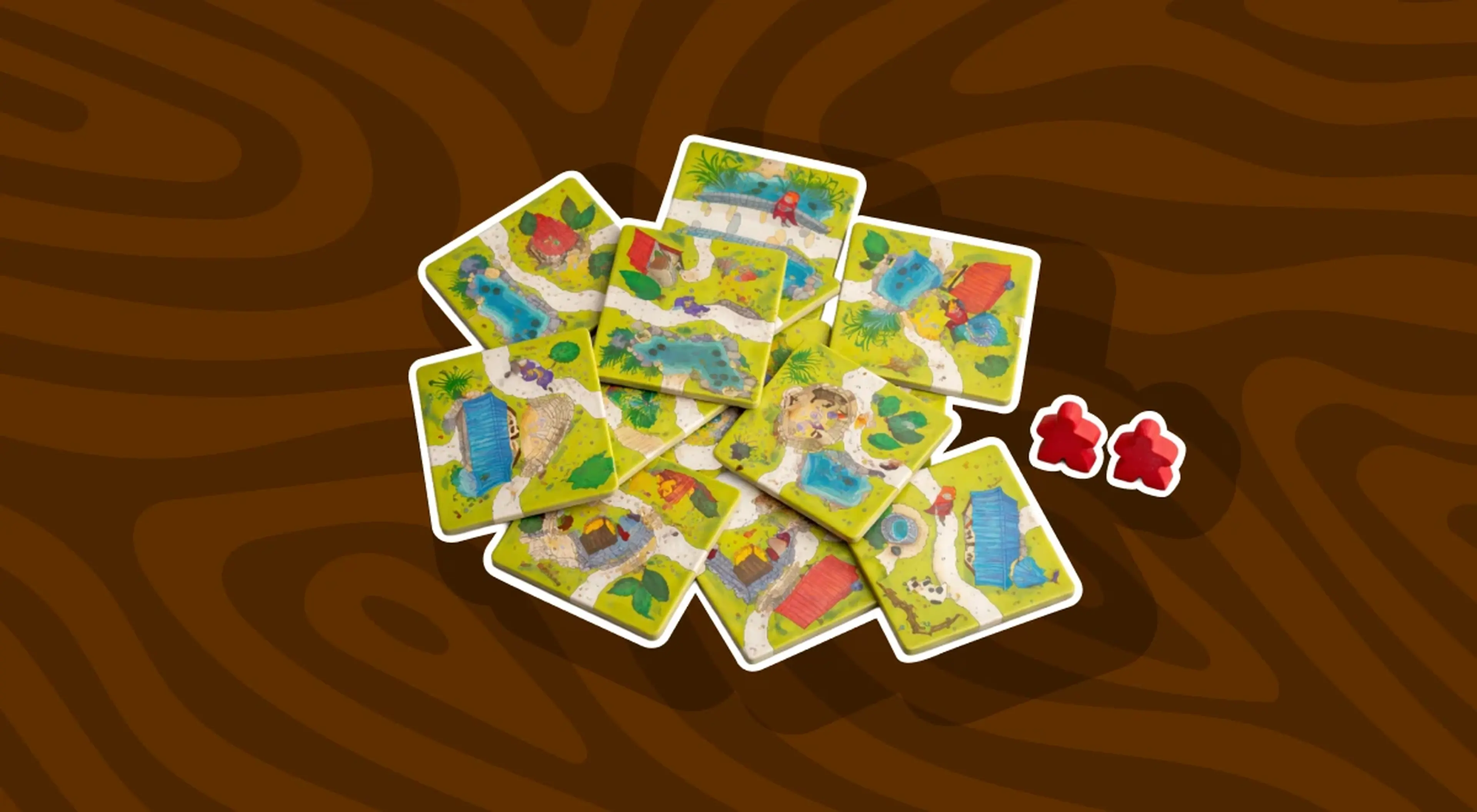
Explaining and arguing out loud is itself a retrieval act, which is why table games stick better than their content suggests. The best teaching games for adults are often adult education games played around a table, and learning through play gets easier with three friends and a timer.
- Codenames. Word association plus reading the people across from you. It teaches almost no facts and sharpens how you explain things, worth saying plainly rather than dressing up. Pricing: a one-time box, listed around $19.95 to $24.99 at US retailers and often discounted.
- Kahoot. Quiz rounds you build yourself on any subject; the most flexible teaching tool here for a group. The useful version is the one where you write the questions, since that forces you to learn the material first. As game-based learning goes, it is the fastest gamified learning you can run from a laptop. Pricing: free for games up to 10 players on a personal account; Kahoot!+ personal plans run about $36 to $300 a year, or $9 to $35 a month.
💡 Skip the boring lists by downloading the Nibble app to level up your brain in 10 minutes flat.
What each kind of game leaves you with after a week
Compare the four groups of learning games for adults by outcome instead of by rating, and the choice gets much simpler.
| Group | What it makes your brain do | What you can honestly do after a week | Typical round | Other people needed |
|---|---|---|---|---|
| Recall games | Pull a stored fact back out on demand | Name facts and explain them out loud | 2 to 10 min | No |
| Reasoning games | Find the pattern or rule under time pressure | Solve that puzzle type faster | 5 to 20 min | No |
| Skill drills | Repeat one narrow task until it is automatic | Perform that exact task better | 5 to 15 min | No |
| Table games | Explain, guess, and argue in real time | Recall what the table argued about | 30 to 60 min | Yes |
Read the first column against the third, and the pattern jumps out. Only the top row produces a sentence you can say to another person, and only the bottom row needs other humans. Everything in between is enjoyable maintenance, which is fine once you know that is what you bought.
Where a ten-minute game fits in an adult week
Ten minutes is the right answer on most days, because the game that survives is the one sized for the gap you have, not the one with the best trailer.
Recall games fit the two- to ten-minute gaps, which are most of the gaps you get, so they belong on your phone. Reasoning games want a deliberate sit-down with coffee. Skill drills need the same slot daily, or the streak quietly dies. Table games need a planned evening.
The common failure is downloading the heaviest option, giving it the lightest slot, then deciding you lack discipline. Learning motivation holds up better when the format matches the window. If your ten minutes currently go to the feed, this list of something better to reach for than the feed has more options.
Online learning games for adults win on availability, since educational games for adults online load in seconds and interactive learning games for adults ask nothing of your schedule. Save the richer educational activities for adults, including interactive educational activities and longer lifelong learning activities for adults, for evenings you plan in advance.
Why Nibble works for scattered adult time
Nibble was built around the gaps rather than a curriculum. You pick your interests at signup, and the For You feed surfaces topics from a library of 35+ subjects, so curiosity leads instead of a syllabus.
Formats shift with your energy. Read a short lesson, watch a video, listen on the commute, play Trivia Quiz or Complete the Picture, or chat with a historical figure like Marie Curie. Every topic includes questions that make you retrieve the answer, the mechanism that keeps facts around.
Daily streaks handle the habit side without nagging, and a session runs anywhere from 1.5 to 15 minutes. With 10M+ downloads and new lessons added weekly, the learning games adults keep coming back to are the ones light enough to open on a Tuesday night.
What people say after a few weeks of short rounds
Reviews tell you more about a learning habit than a feature list does. These three Nibble users kept going long enough to notice a difference.
Ela, who travels for TV production, used to lose an hour to her feed in every airport. Her line now: "Now I reach for a Biology lesson instead." She had written herself off as someone who quits apps, and that proved wrong.
Fredys Caballero finished 30 Art lessons a few at a time on Sunday mornings. The payoff landed during a trivia board game with his girlfriend and her mom: "I didn't miss a single art question." Both of them asked where that came from.
Richard, a car salesman with two daughters, swapped his 7:30 a.m. Facebook habit for five minutes of History and Art. He sums up the trade: "I'm getting more out of less time." He can also tell a Monet from a Munch now.
Play one round tonight, then open Nibble tomorrow
Pick one of the fun learning games for adults above, play a single round tonight, and run the one-sentence test in the morning. If a sentence shows up, keep the game. If it does not, you have saved yourself a subscription. For the group that passes that test reliably, with short rounds, 35+ topics, and games built around retrieval, download Nibble and start tonight.

FAQs about learning games for adults
What is the best learning game for adults?
No single title wins, because the answer depends on the slot you play in and who is sitting beside you. A useful shortcut: run two candidates for a week each, then keep the one you reopen without a reminder. Habit beats star ratings here, since a game you abandon on day four teaches you nothing at all.
What is the best free learning app for adults?
Free tiers differ mainly in what they hold back. Some cap how many rounds you play a day, some hide the explanation behind a paywall, and some stay open but run ads between rounds. Check which one applies before you commit, because an app that hides the explanation is selling you the question alone.
What are the top 5 games for adults?
Most top-five lists mix party boxes, puzzle apps, and board games with no shared yardstick, so the ranking tells you little. Sort by setting first: a solo commute, a shared table, or a desk break. The five titles that earn a spot change completely across those three, which is why one list rarely travels.
What are some fun learning activities for adults?
Plenty sit away from a screen. Museums run free audio tours worth an hour, libraries host language exchange evenings, and pub quizzes hand you retrieval practice with a drink in hand. Pair one with a documentary, and you get the same question-and-answer loop apps automate, with company attached and no subscription to cancel.
What is the most fun learning game?
Fun tends to come from stakes rather than subject matter. A timer, a leaderboard, or a friend who groans when you win raises the feeling more than the content does. That is why an average quiz with four people around the table often beats a beautifully built solo app on a quiet Tuesday night.
How to make learning fun as an adult?
Attach it to something you already enjoy. Queue an audio lesson with your usual walk, quiz a friend over coffee, or pick subjects tied to a trip you are planning. Rotating topics before boredom arrives helps too. The aim is a session you look forward to rather than one you schedule and dread.
What are three things all adult learners want?
Research on adult education, going back to Malcolm Knowles in the 1970s, keeps landing on the same three: control over what they study, material that connects to their own experience, and a reason the learning matters now. Games cover the first two easily. The third one you supply yourself, by choosing subjects you have a use for.
What are the 7 essential life skills for adults?
Lists vary by source, though most include communication, money management, problem-solving, time management, cooking and basic health, digital literacy, and emotional regulation. Games reach a couple of these, honestly, mainly problem-solving and money basics. The rest need practice in the real world, which is worth knowing before you expect an app to cover them.
Published: Apr 17, 2026
 128K+ ratings worldwide
Keep your curiosity sparked with Nibble
Join 10M+ people and discover bite-sized ideas across 35+ topics with an all-around knowledge app
