
9 Brain Exercises for Your Foggy Afternoon Slump
It's 4 p.m., the coffee has worn off, and your brain has quietly switched to autopilot. Your thumb finds your phone before you've even decided to pick it up.
Last updated: Nov 19, 2026
Read time: 8 min
By Nibble Team
Nibble's Editorial Team
Our editorial team loves exploring how things work and why. We’re guided by the idea that people stay curious throughout their lives — they just need engaging stories and ideas to reignite that curiosity.
Brain exercises challenge memory, attention, or reasoning enough to pull your mind out of coast mode and back into gear, supporting brain health over time. This exact window, awake but understimulated, is when they do the most good.
According to a large randomized controlled trial on cognitive health in older adults tracked by the National Institute on Aging, targeted reasoning and processing-speed training was linked to less cognitive decline than no training.
That same afternoon lull could as easily pull you toward a two-minute puzzle or a quick trivia round instead, or open Nibble for a lower-effort reset.
Quick summary: What counts as a real brain exercise?
A real brain exercise works more than one mental skill at a time, not just memory in isolation.
- Crossword puzzles are linked to delayed memory decline in some observational research.
- Card games and tai chi both improve thinking skills in older adults.
- Learning a new language builds cognitive reserve against cognitive decline.
- Physical exercise increases blood flow and keeps your brain active by supporting new cells.
- Variety matters more than repetition, so rotating activities boosts cognitive performance better than one puzzle type.
Keep reading for the full list of nine brain exercises you can start tonight.
1. Solve a timed crossword puzzle
Crossword puzzles are among the more studied casual brain exercises, and one often-cited study suggests regular solving is associated with delayed memory decline by up to seven years, though the link is correlational rather than causal. They pull on language retrieval, pattern recognition, and problem-solving skills at once.
Start tonight with a five-minute puzzle from a newspaper app or an old paperback; you don't need to finish it. The goal is friction, not completion.
Timing yourself after a few weeks adds a processing speed element, pushing your brain speed without raising the stakes — a low-cost way to exercise your brain during a commercial break or a quiet lunch.
2. Play a hand of a strategic card game
Some research associates playing card games, like bridge, rummy, or solitaire variants, with better working memory and decision-making, and studies specifically point to improved thinking skills in older adults, though evidence for middle-aged adults is more limited.
Every round means tracking what's been played, predicting an opponent's next move, and adjusting your strategy as you go. Start with a simple app version or an old deck from a kitchen drawer.
Playing with others also builds a light social habit that supports mental wellbeing. Fifteen minutes before bed beats scrolling and gives your evening a stopping point.
3. Try a Stroop effect drill
The Stroop Effect exercise asks your brain to name the ink color of a word like "red" printed in blue, a small conflict that trains cognitive flexibility every time you repeat it. Free printable versions and apps exist, and most sessions take under three minutes.
It works by forcing your brain to override an automatic reading response, exercising executive function in a concentrated burst. Try it as a reset between tasks. Three short rounds a day is enough to notice sharper mental agility.
4. Pick up a new language for ten minutes
Research suggests language learning can improve cognitive flexibility well past working age, pointing to a protective association with cognitive aging, though findings are mixed.
Learning a new language also builds cognitive reserve that may delay cognitive decline, since the skill compounds: grammar builds on vocabulary, and vocabulary builds on listening comprehension.
Start with a free app and one short lesson before dinner. Beyond the cognitive training angle, it adds a useful life skill, which keeps motivation higher than most pure brain training games tend to manage.
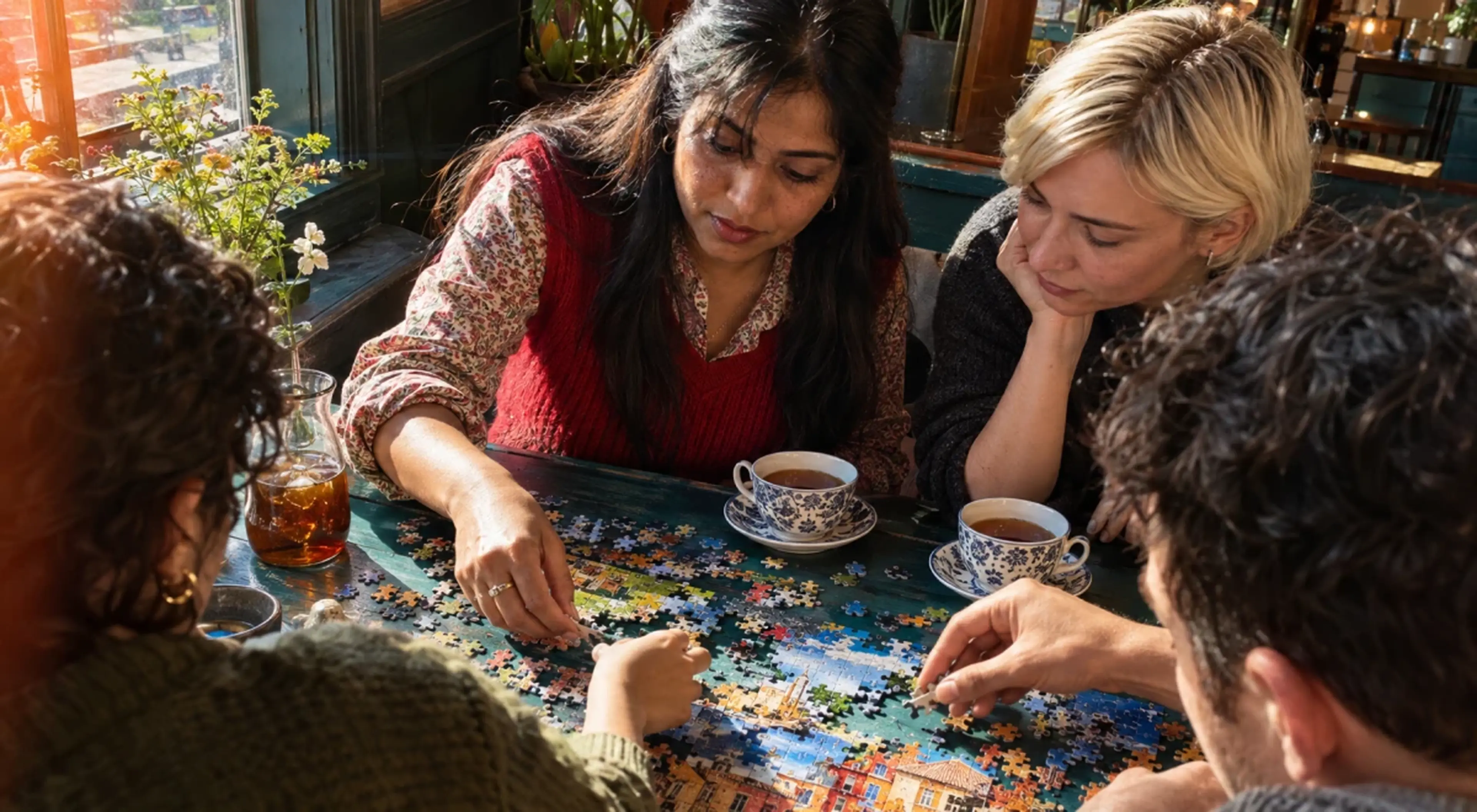
5. Assemble part of a jigsaw puzzle
Playing jigsaw puzzles engages multiple cognitive abilities at once: visual-spatial reasoning, short-term memory for piece location, and patient problem-solving. Leave a puzzle out on a table so it invites five-minute sessions instead of a full sitting.
Unlike screen-based brain games, handling the pieces adds a tactile, slower-paced quality many find calming after a high-stimulation day. Tracking a shape in your head while scanning a messy pile is a real workout for memory recall. Rotate puzzles by difficulty once the easy ones stop challenging you.
6. Add twenty minutes of tai chi
Several small trials suggest tai chi, especially combined with mental exercises, can improve thinking skills for older adults, though results vary by study and population.
Its slow, deliberate movements demand sustained focus and sequencing memory together. It also counts as physical movement, a brain-healthy habit that supports blood flow and general physical health.
A free video session at home is enough to start. Pairing a calming physical practice with light cognitive demand suits anyone whose joints need a break from higher-impact activity but still wants a real fitness benefit.
7. Load a strategic board game
Strategic board games challenge cognitive flexibility and working memory by requiring players to track multiple moving pieces, anticipate an opponent's next move, and adjust a plan mid-game. Chess, Go, and even modern strategy games fit here. A single game with a partner or a phone app's AI opponent gives you a full session of active reasoning.
Unlike passive screen time, a board game demands sustained problem-solving from the first move to the last. Keep a board set up at home so it's as easy to reach for as a phone during a slow evening.
8. Play a cognitively demanding computer game
Some systematic reviews report modest, game-specific benefits for processing speed and attention from certain video games, particularly strategy or puzzle titles, though effects vary by study design and don't always generalize to everyday tasks.
Brain training games built to target memory or reaction time tend to show the clearest short-term gains from playing video games this way.
Fifteen to twenty minutes is enough. Longer play tips into passive habit rather than active cognitive training. Choose titles that force decisions under light time pressure rather than ones that auto-play content for you.
9. Practice an instrument for a few minutes
Picking up a musical instrument, even briefly, works memory, fine motor coordination, and auditory processing all together, making it one of the more demanding brain training activities on this list. Reading notation, moving your fingers to match it, and listening for accuracy happen simultaneously. A beginner doesn't need a lesson to start.
Ten minutes with a keyboard app or an old guitar pulled from a closet counts. The learning curve itself is the benefit: a brain building new brain connections while acquiring an unfamiliar skill gets more out of the session than one repeating something already mastered.
🧩 Need a lower-effort way to squeeze in a mental workout between tasks? Nibble turns a spare five minutes into a quick lesson, quiz, or game. Try Nibble today.
Why brain exercises matter beyond the slump
Cognitive health is not a fixed trait. It's a trainable state, shaped over years by regular brain training, physical exercise, and mentally stimulating activities, not by a single good afternoon.
Cognitive decline is not inevitable, either. Early signs like slower word recall or occasional forgetfulness don't automatically signal mild cognitive impairment or Alzheimer's disease.
Staying mentally sharp through daily habits works as a potential protective factor, and research suggests cognitive aging affects processing speed and memory recall differently from person to person.
Building cognitive reserve through varied activity, not one puzzle type, is what the evidence points toward as the more reliable way to boost brain function and support cognitive fitness.
Physical fitness and regular exercise play a role too, supporting blood flow that several studies connect to new brain cells and a healthier brain structure — one reason doctors link physical health to mental health.
That combination keeps a healthy brain and a healthy mind working together, part of what can boost memory over the years rather than in the moment.
🧩 A healthier brain starts with small, repeatable habits. Nibble's short daily sessions are built to fit into exactly those moments. See how Nibble fits in.
How to build a regular brain training habit that sticks
Starting small beats starting big. One item from the list, five minutes, the same time of day, will outlast an ambitious hour-long plan abandoned within a week.
Pair a brain exercise with a habit you already have, after lunch or during a commute, so it becomes automatic. Rotate between memory games, tai chi, and language learning to keep multiple skills engaged instead of over-training one.
Randomized controlled trials on cognitive training generally find that this kind of varied, repeated practice does more for brain function and brain power than any single activity alone, and plenty of free brain games exist for anyone who wants to start without spending anything.
The table below breaks down a few options by time, cost, and the skills they target, in case rotating through a few habits suits you better than one single routine.
| Activity | Time needed | Cost | Primary skill targeted |
|---|---|---|---|
| Crossword puzzles | 5-15 min | Free-low cost | Language, memory recall |
| Card games | 10-20 min | Free | Working memory, decision speed |
| Jigsaw puzzle | 5-30 min | Low cost | Visual-spatial reasoning |
| Tai chi | 15-20 min | Free (video) | Focus, physical movement |
| Language learning app | 5-10 min | Free-low cost | Cognitive flexibility, memory |
| Strategy board game | 20-40 min | Low-moderate cost | Executive function, planning |
| Nibble lessons and games | 2-15 min | Subscription | Multiple cognitive abilities, general knowledge |
What Nibble users say about staying mentally sharp
For people who want the brain exercise habit without juggling a separate app and a puzzle book, a few Nibble users describe folding it into moments they already have in everyday life.
Angela, who studied history in college, still finds Nibble's History and Space lessons surprisingly challenging, a reaction she writes about in Angela's history degree story.
Bea turned a few minutes of Nibble each day into a broader push toward self-discipline, describing the habit in Bea's self-discipline story.
Ela used to fill every airport wait and work break with aimless scrolling, and now reaches for Nibble instead, a shift she details in Ela's airport habit story.
Fredys Caballero has worked through 30 Art lessons on Nibble and says it has changed how he notices the world around him, a change he lays out in Fredys's Art lessons story.
Make brain exercises part of tonight with Nibble
The nine brain exercises above work best as a repeated habit layered into an already-busy week, not a one-time effort. They need no gym membership, dedicated support team, or formal course. A deck of cards, a crossword, or a short lesson before bed all count as regular brain training when done consistently.
Nibble gives that habit a single home and has been downloaded by more than 10 million users worldwide. Its daily streaks and mix of quizzes, games, and quick lessons help you stay mentally sharp without another chore on your list.
For anyone who wants a single place to rotate between quizzes, short lessons, and games without planning each session separately, try Nibble tonight and see which topic pulls you in first.

FAQs about brain exercises
What are the best brain exercises to improve memory?
Crossword puzzles, card games, jigsaw puzzles, and language learning all rank among the better-studied options for memory. Each works a slightly different type of memory recall, from word retrieval to spatial tracking, so rotating between them tends to help more than repeating just one activity over and over.
How often should you do brain exercises?
Short daily sessions of five to twenty minutes generally beat occasional long ones. Consistency matters more than duration, since the brain responds to repeated, varied challenges over weeks and months rather than one marathon session now and then.
What is the difference between brain training and brain exercise?
Brain training usually refers to structured, often app-based programs that repeat drills targeting one specific cognitive skill, like processing speed. Brain exercise is the broader category, covering any mentally stimulating activity, including puzzles, card games, instruments, and learning a new language, whether or not it's app-based.
How much does it cost to start a brain training habit?
Most of the options on this list cost nothing. Crosswords, rummy nights, and tai chi videos are free or close to it, while jigsaw puzzles and instruments involve a small upfront cost. Paid cognitive training apps add structure and variety for a subscription fee, but a free habit works just as well if you stay consistent.
At what age should someone start doing brain exercises?
There is no minimum age. Brain exercises benefit middle-aged adults and older adults the most in current research, since cognitive decline risk rises with age, but building habits like crossword puzzles or language learning earlier in life helps build cognitive reserve before it is needed, supporting mental sharpness for decades.
Can physical exercise improve cognitive function?
Yes. Physical activity increases blood flow to the brain, which supports new brain cells and a healthier brain structure over time. Pairing physical movement with a mental task, like tai chi's combination of sequencing and balance, appears to offer more cognitive benefit than either physical exercise or mental exercise alone.
What's a common mistake people make when trying brain training activities?
The biggest mistake is sticking to one activity and expecting broad results. A single crossword habit mostly sharpens language retrieval, not working memory or planning. Another common error is treating brain exercises as a cure for memory loss or cognitive impairment rather than one of several potential protective factors alongside sleep, diet, and social connection.
Do brain games really work for the brain?
It depends on the game. Targeted cognitive training programs can improve a specific skill, like processing speed or working memory, fairly reliably. Broader claims about brain games raising general intelligence are weaker, and a systematic review of the evidence generally finds narrow, skill-specific gains rather than sweeping improvement.
Published: Nov 19, 2026
 128K+ ratings worldwide
Keep your curiosity sparked with Nibble
Join 10M+ people and discover bite-sized ideas across 35+ topics with an all-around knowledge app
